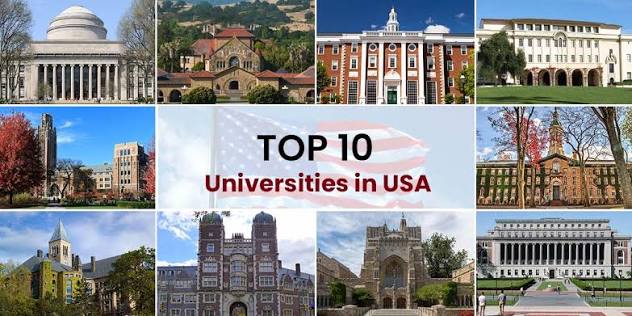
Choosing a university in the United States means navigating one of the most competitive higher education landscapes on Earth. U.S. institutions dominate top international tables—such as the QS World University Rankings and the Times Higher Education (THE) World University Rankings—thanks to unmatched research budgets, world-class faculty, and immense institutional endowments.
Whether you are aiming for groundbreaking laboratory research, elite business networks, or pioneering technology development, here is a detailed breakdown of the top 10 universities in the United States, complete with academic strengths, global standings, and admission insights.
The Top 10 U.S. Universities
1. Massachusetts Institute of Technology (MIT)
- Location: Cambridge, Massachusetts
- Global Standing: Frequently ranked #1 globally by QS World University Rankings
- Core Strengths: Engineering, Computer Science, Artificial Intelligence, Economics, Physics
- Official Website: mit.edu
Located along the Charles River, MIT is synonymous with technological innovation and scientific rigor. Home to revolutionary hubs like the MIT Media Lab and the CSAIL (Computer Science and Artificial Intelligence Laboratory), MIT fosters an intense hands-on problem-solving culture. Alumni and faculty have founded thousands of global enterprises, generating economic output equivalent to a major world economy.
2. Harvard University
- Location: Cambridge, Massachusetts
- Global Standing: Consistently top-tier across QS, THE, and ShanghaiRankings (ARWU)
- Core Strengths: Law, Business, Medicine, Government, Humanities, Life Sciences
- Official Website: harvard.edu
Founded in 1636, Harvard University is the oldest higher education institution in the United States. Its massive financial endowment—the largest of any academic institution worldwide—supports generous zero-loan financial aid through the Harvard Financial Aid Initiative. Housing eight U.S. Presidents and scores of Nobel Laureates, Harvard’s alumni network spans the highest echelons of global leadership.
3. Stanford University
- Location: Stanford, California
- Global Standing: Top 3 global research powerhouse
- Core Strengths: Computer Science, Entrepreneurship, Engineering, Venture Capital, Law
- Official Website: stanford.edu
Situated in the heart of Silicon Valley, Stanford University has fueled the modern tech boom more than any other institution. Companies like Google, Hewlett-Packard, and Sun Microsystems were founded by Stanford graduates. Students benefit from close access to Sand Hill Road venture firms, cutting-edge research facilities like the SLAC National Accelerator Laboratory, and a warm West Coast campus environment.
4. Princeton University
- Location: Princeton, New Jersey
- Global Standing: Consistently ranked #1 in U.S. News & World Report National University Rankings
- Core Strengths: Mathematics, Theoretical Physics, Public Policy, Humanities
- Official Website: princeton.edu
Unlike many of its peer research institutions, Princeton University places a primary focus on undergraduate education. Every undergraduate student completes a senior thesis or independent research project guided by world-renowned faculty. Its zero-debt financial aid program guarantees that families making under specified income thresholds pay zero tuition, room, or board.
5. California Institute of Technology (Caltech)
- Location: Pasadena, California
- Global Standing: Top 10 globally, maintaining an extraordinarily high research output per student
- Core Strengths: Astrophysics, Aerospace Engineering, Geosciences, Applied Physics
- Official Website: caltech.edu
With a student body of roughly 1,000 undergraduates and 1,400 graduate students, Caltech is an intimate, high-octane research engine. Caltech manages NASA’s famous Jet Propulsion Laboratory (JPL), playing a leading role in space exploration missions, robotic planetary rovers, and deep-space observation.
6. University of California, Berkeley (UC Berkeley)
- Location: Berkeley, California
- Global Standing: Highest-ranked public university in the U.S.
- Core Strengths: Chemistry, Computer Science, Environmental Studies, Sociology, Public Health
- Official Website: berkeley.edu
As the flagship campus of the University of California system, UC Berkeley proves that public higher education can match the elite private Ivy League in research output and academic distinction. From discovering 16 chemical elements to spearheading the Free Speech Movement, Berkeley remains a global center for scientific discovery and social activism.
7. Columbia University
- Location: New York City, New York
- Global Standing: Top 10-15 worldwide
- Core Strengths: Journalism, International Relations, Finance, Literature, Medicine
- Official Website: columbia.edu
Located in Upper Manhattan, Columbia University offers direct integration into New York City’s global finance, media, and cultural networks. Columbia administers the prestigious Pulitzer Prizes through its Graduate School of Journalism, while its famous core curriculum forces all undergraduates to engage deeply with foundational texts in philosophy, literature, and art history.
8. University of Chicago (UChicago)
- Location: Chicago, Illinois
- Global Standing: Top 10 global research authority
- Core Strengths: Economics, Physics, Sociology, Law, Quantitative Analysis
- Official Website: uchicago.edu
Renowned for intense intellectual rigor and critical thinking, the University of Chicago has produced more than 90 Nobel Laureates. The “Chicago School of Economics” fundamentally reshaped global financial policy. Its unique quarter system speeds up academic pacing, allowing students to complete deep research projects across multi-disciplinary fields.
9. University of Pennsylvania (Penn)
- Location: Philadelphia, Pennsylvania
- Global Standing: Top 15 globally
- Core Strengths: Business (Wharton), Medicine, Bioengineering, Nursing, Law
- Official Website: upenn.edu
Founded by Benjamin Franklin in 1740, Penn emphasizes practical, interdisciplinary learning. It is home to the world-famous Wharton School of Business, producing global leaders in corporate finance, venture capital, and real estate. Penn’s single contiguous campus allows law, medical, engineering, and business students to collaborate seamlessly.
10. Yale University
- Location: New Haven, Connecticut
- Global Standing: Top 10-15 globally
- Core Strengths: Drama & Arts, History, Political Science, Law, Molecular Biology
- Official Website: yale.edu
Distinguished by its famous residential college system, Yale University offers an intimate community structure inside Gothic architectural grounds. Yale Law School is consistently ranked as the nation’s premier legal institution, producing Supreme Court justices, international diplomats, and heads of state.
Quick Comparison Matrix
| University | Institutional Type | Acceptance Rate | Primary Strengths |
| MIT | Private (STEM Focus) | ~4% | Engineering, Computer Science, AI |
| Harvard | Private (Ivy League) | ~3-4% | Law, Business, Humanities, Medicine |
| Stanford | Private | ~4% | Tech, Entrepreneurship, Venture Capital |
| Princeton | Private (Ivy League) | ~4-5% | Mathematics, Public Policy, Physics |
| Caltech | Private (STEM Focus) | ~3% | Space Sciences, Physics, Aerospace |
| UC Berkeley | Public | ~11-14% | Chemistry, Engineering, Social Sciences |
| Columbia | Private (Ivy League) | ~4% | Journalism, Finance, International Affairs |
| UChicago | Private | ~5% | Economics, Quantitative Analysis, Sociology |
| Penn | Private (Ivy League) | ~4-5% | Finance (Wharton), Bioengineering, Law |
| Yale | Private (Ivy League) | ~4-5% | Law, Drama, History, Political Science |
Key Ranking Criteria to Understand
When evaluating U.S. universities through global ranking platforms like QS World University Rankings or Times Higher Education, keep in mind how scores are weighted:
- Academic & Employer Reputation: Global surveys assessing institutional prestige among scholars and corporate recruiters.
- Citations per Faculty: Measuring the real-world impact and volume of research published in academic journals.
- Faculty-to-Student Ratio: Tracking class sizes and individual mentorship opportunities.
- International Diversity: Assessing international student enrollment and global faculty hires.