

Fact-Check: Viral Claims of Russian and Chinese Fighter Jet Deliveries to Iran Remain Unconfirmed
 admin
4 min read
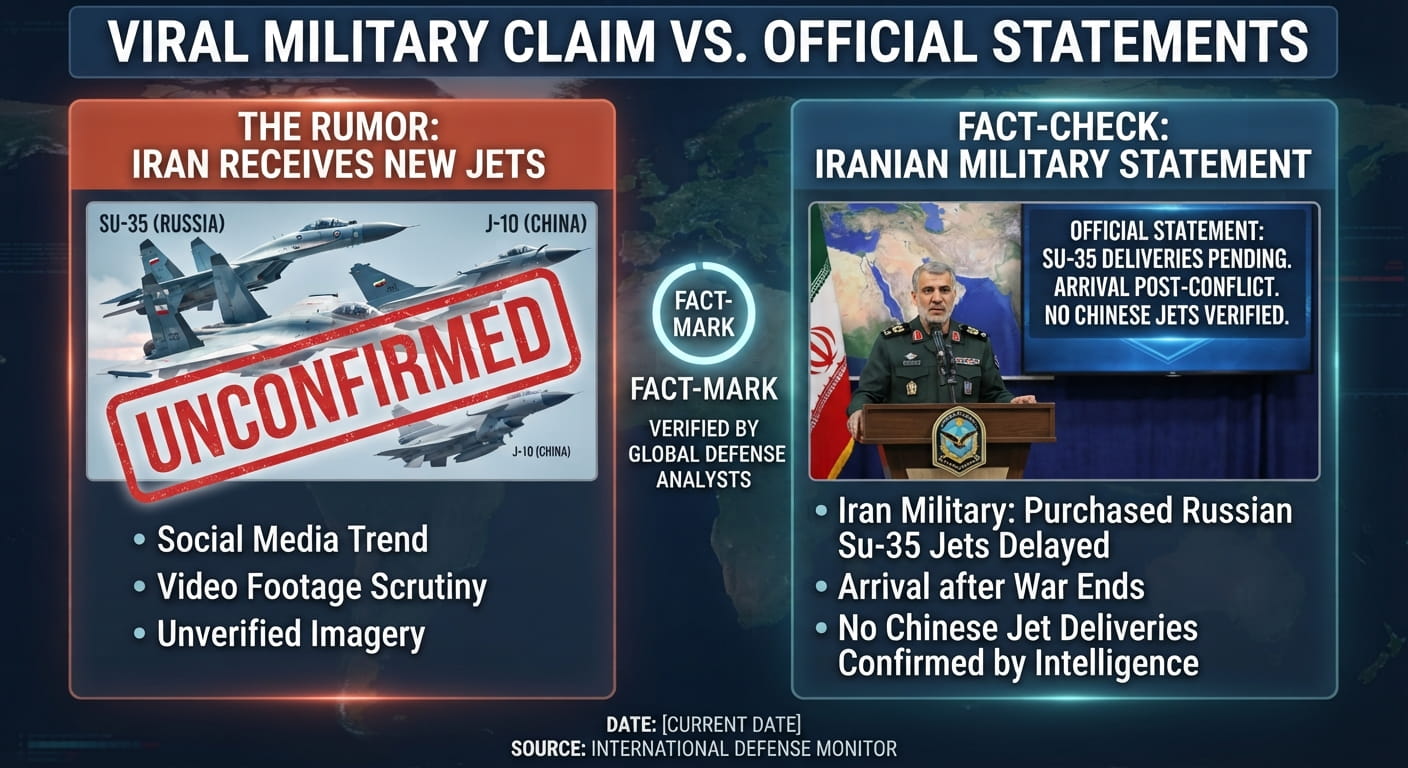
November 24, 2026 — Viral claims circulating across social media platforms alleging that Iran has just taken delivery of advanced new fighter jets from Russia and China are unsubstantiated by official military statements, satellite imagery, or defense intelligence.
In fact, Iran’s own military leadership explicitly stated earlier this month that its long-awaited Russian Sukhoi Su-35 multirole fighters will not arrive until after the ongoing regional conflict concludes, while zero verified deliveries of Chinese combat aircraft have occurred. For continuous, verified coverage of Pentagon briefings and global defense developments, visit US Feed Now.
The Insider
Tehran Confirms Russian Su-35 Jets Are Delayed Until Post-War
Speculation surrounding an imminent boost to the Islamic Republic of Iran Air Force (IRIAF) surged online following renewed friction in the Persian Gulf. However, public remarks from senior Iranian commanders directly contradict rumors that Su-35 squadrons are currently entering service.
The Insider
In interviews with Iranian media outlets Tabnak and BitRun—reported internationally by The Jerusalem Post and The Insider—Iranian Armed Forces spokesperson Brig. Gen. Mohammad Akraminia confirmed that while procurement contracts and pilot training were finalized prior to the outbreak of war in late February 2026, the aircraft remain undelivered.
The Jerusalem Post
“These aircraft were supposed to arrive before the war. After this war, God willing, we will receive these aircraft and upgrade our air fleet.” — Brig. Gen. Mohammad Akraminia, Iranian Armed Forces Spokesperson
The Jerusalem Post
Defense analysts highlight several operational and geopolitical reasons behind Moscow’s hold on the transfer:
Protecting High-Value Assets: As defense analyst Farzin Nadimi noted in an assessment for The New Arab, Moscow is reluctant to deliver high-profile fourth-generation-plus fighter jets during active hostilities, where they could be targeted and destroyed on the ground by U.S. or Israeli airstrikes.
The New Arab
Damaged Basing Infrastructure: Open-source defense reporting from Defence Security Asia points out that key Iranian airbases slated to house the new jets—such as Hamadan—have suffered significant wartime damage, complicating maintenance and hardened shelter logistics.
Clash Report
Limited Wartime Transfers: While Russia previously delivered Yak-130 trainer aircraft in 2023 and Mi-28NE attack helicopters following the June 2025 conflict, heavy frontline fighter deliveries remain frozen.
The New Arab
No Verified Deliveries of Chinese Fighter Jets
Alongside claims about Russian aircraft, viral posts have falsely alleged that China quietly airlifted J-10C or other combat jets to Tehran. Neither Beijing, Tehran, nor Western defense agencies—including U.S. Central Command (CENTCOM)—have reported any transfer of Chinese military aircraft to Iran.
While investigative reporting by outlets such as The Wall Street Journal and Iran International has documented shipments of dual-use industrial components, chemical precursors, and drone parts moving between Chinese entities and Iran throughout 2026, Beijing has consistently avoided direct transfers of major complete weapon platforms like fighter jets. Earlier in 2026, China’s Foreign Ministry flatly rejected separate media rumors of planned Chinese air-defense launcher shipments to Iran as “completely groundless”.
thecradle.co
What Iran’s Air Force Actually Flies Today
Without new Russian or Chinese deliveries, Iran’s operational fighter fleet continues to rely heavily on aging platforms—including pre-1979 American-made F-14 Tomcats, F-4 Phantoms, and F-5s, alongside Soviet-era MiG-29s and Su-24s. Because these legacy airframes lack modern stealth and avionics to contest fifth-generation U.S. and Israeli fighters, Tehran has leaned primarily on ballistic missiles, drones, and underground bunker networks rather than air-to-air combat.
Clash Report
Until official flight-tracking telemetry, commercial satellite imagery, or verified defense ministry announcements emerge, claims of newly arrived Russian and Chinese fighter squadrons in Iran should be treated as online misinformation. Follow ongoing fact-checks and Middle East security reporting on the US Feed Now homepage.
Summary of Links Included in the Article
Internal Link 1: https://usfeednow.com (Anchor: US Feed Now)
Internal Link 2: https://usfeednow.com (Anchor: US Feed Now homepage)
External Link 1: https://www.jpost.com/middle-east/iran-news/article-913451 (The Jerusalem Post – coverage of Brig. Gen. Mohammad Akraminia’s Su-35 post-war delivery statement)
External Link 2: https://theins.press/en/news/299063 (The Insider – detailed report on Iran’s Russian Su-35 timeline and pilot training)
External Link 3: https://www.newarab.com/analysis/su-35s-and-s-400s-iran-looks-russia-rebuild-its-air-power (The New Arab – expert defense analysis on why Moscow is delaying major deliveries during active hostilities)
External Link 4: https://defencesecurityasia.com/en/iran-russian-su35-fighters-post-war-delivery-airpower-gap/ (Defence Security Asia – analysis of Iran’s airpower gap and airbase infrastructure challenges)
External Link 5: https://www.iranintl.com/en/202609248582 (Iran International – reporting on the scope and limits of Chinese dual-use shipments to Iran)
External Link 6: https://www.centcom.mil/ (U.S. Central Command – authoritative U.S. defense portal)