
Lemo-Opuscar Turns Code Into Short Films Without Relying on Generative Video Models
 admin
3 min read
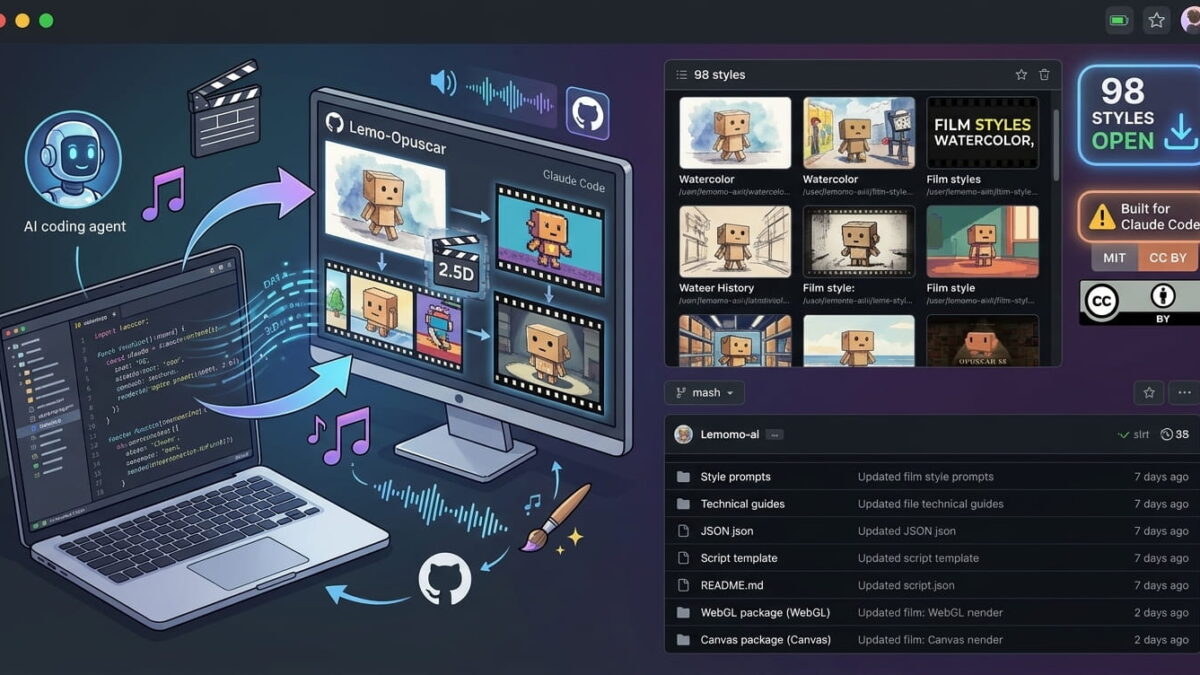
November 27, 2026 — A fast-moving open-source project on GitHub, Lemo-Opuscar (lemomo-ai/lemo-opuscar), is drawing developer attention for taking an unconventional approach to AI filmmaking: instead of generating pixels through diffusion or autoregressive video models, it directs coding agents to write code that renders, scores, and narrates short films frame by frame.
Created by Lemomo (@lemomo_ai) and LemoLab, the repository provides reusable style prompts, technical rendering guides, and custom style workflows designed primarily for Claude Code and compatible AI coding agents. For continuous, verified updates on emerging AI tools, developer platforms, and breaking tech news, visit US Feed Now.
How Code-Driven Filmmaking Works in Lemo-Opuscar
Traditional generative video tools synthesize frames directly from latent diffusion or video-transformer weights. Lemo-Opuscar flips that pipeline by treating the AI agent as a technical director and programmer that builds visual sequences deterministically in code.
According to documentation on the Lemo-Opuscar GitHub Repository and technical breakdowns by ExplainX and Antigravity Skills:
- No Video-Generation Model Required: Films are rendered programmatically—using browser/Canvas or WebGL scenes, audio mixing tools, and text-to-speech narration—rather than sampling video frames from a neural video generator.
- Style Prompts + Demo Films: Each style in the library pairs a reusable style prompt (
STYLE.md) and technical specifications with a reference demo film and preview assets so coding agents can reproduce consistent visual grammar. - Structured Direction & Self-Checks: The project guides agents through dedicated rulebooks—such as
DIRECTOR.mdfor pacing, camera, and storytelling, andTECHNIQUE.mdfor rendering and audio—before generating and inspecting output clips. - Custom Style Creation: Beyond using built-in styles from the Lemo-Opuscar Gallery, users can adapt existing styles or design custom visual rules interactively and preview style frames and short test reels before saving them.
Visual Families, Setup Requirements, and Practical Trade-Offs
As the repository has evolved across autumn 2026 releases—expanding from dozens of styles toward a broader catalog of up to 99 documented film styles—its library spans diverse visual approaches, from newsreels, motion graphics, and diagrams to painterly, sketch, and traditional craft aesthetics.
Developers evaluating the tool for production or experimentation should weigh several practical details highlighted in DeepWiki’s Repository Guide and AgentSkillsHub:
- Local Runtime Dependencies: Running the full pipeline locally typically requires Node.js, a modern
ffmpegbuild, and Python tooling alongside an agent environment such as Claude Code. - Time & Token Cost: Because an agent plans shots, writes rendering code, executes builds, and inspects results iteratively, generating a complete film can take substantial agent runtime and token usage compared with single-prompt cloud video generators.
- Best Fit vs. Photorealism: Code-rendered films excel at structured explainers, motion graphics, data/document visuals, and stylized sequences where scriptability and editability matter, whereas photorealistic live-action or complex organic physics remain better suited to dedicated video models.
- Licensing Nuances: While code and documentation use permissive open-source terms (MIT) and demo stills/films carry CC BY 4.0 terms with specific third-party/voice exclusions noted in the repo, creators should review license files before commercial reuse.
For software engineers and AI creators interested in reproducible, code-first motion storytelling, lemomo-ai/lemo-opuscar offers a clear blueprint for turning agentic coding workflows into visual media.
Link https://github.com/lemomo-ai/lemo-opuscar